





Eye For Film >> Movies >> La Carn (2025) Film Review


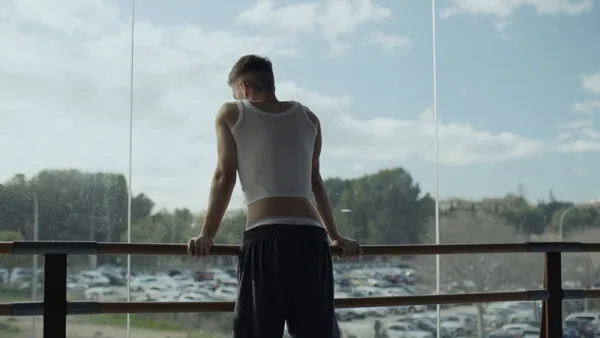

There’s a split second in La Carn when you realise how little time a body is given to become a person. Lluís Garau logs on to Chatroulette, a random video-chat site where men from a seemingly infinite pool are paired and can skip each other instantly, and before he can say hello the other has already clicked away. Director Joan Porcel builds a hybrid feature around that tiny interval, a speed test between desire and disposal.
Garau plays a version of himself, a dancer in Palma, Mallorca, whose project grows out of an eponymous performance piece he has been touring across Europe, folding live Chatroulette encounters into his choreography. Onstage he turns those rituals into dance; offstage he keeps returning to the site, hoping someone will stay. There’s something quietly daring about dragging a space built for discreet, disposable encounters onto a stage and letting those fleeting exchanges play out in public. Everyone else is pixels: men, or their manhoods, flicker past in glitchy thumbnails, usually with questions like, “Gay or straight?”, “Top or bottom?”, “How old are you?” and “What are you looking for?” When someone hits skip, a small icon swells and contracts like a stylised heart, the interface quietly mocking his attempts at intimacy.
Lluís isn’t just acted upon by this ecosystem. Early on, he goes Live on Instagram and spins a story about a bus driver hitting on him and touching him inappropriately. It’s the kind of embellished or simply invented anecdote that casts him as both desirable and under threat, a small act of self-mythologising for whoever happens to be watching. Buried in the comments is an ominous warning from “Banya Negra 274,” a handle he barely registers, even though it will later follow him into his inbox.
Out of the blur of anonymous torsos, one “discreet” user keeps returning: a man in a black balaclava, with a deep, calm voice and unmistakable green eyes. Their chats grow more intimate and edge towards a meeting, just as emails from Banya Negra 274 begin to land in his inbox. The messages point to a real case of a man burned to death in the coastal park Es Carnatge in Palma, an actual cruising spot whose name rhymes darkly with the film’s title, and warn that Lluís will “burn the same way”.
When the masked man proposes a late-night rendezvous in that same park and promises “protection” from any harm, the flirtation curdles into something more ominous. Porcel taps into a specific queer vulnerability: the way more feminine, less physically imposing men can end up seeking safety from the very strangers they fear. Conventionally masculine men so often trigger a double question: will this man love me or kill me, is he a closeted gay guy in trouble or an openly homophobic basher looking for prey? It’s a risk and sensation many gay men of the modern world will recognise. Before the meeting, Lluís walks through Es Carnatge in daylight, then scours Street View, zooming in on blurred faces around the park as if he might recognize his masked admirer; a tragicomic attempt to “verify” reality inside platforms that erase bodies by design.
As the emails pile up, the danger shifts register. The anonymous sender threatens to expose his online life to his parents. What looms is not just potential violence in a dark park but the oldest queer terror: being outed and shamed at home, the screens collapsing and reaching back into his family life.
Visually and sonically, La Carn is finely tuned. The title sequence shows a masked figure dropping raw meat into a swimming pool, the submerged camera losing sight of their towering features as soon as the flesh hits the water, bait hurled into opaque depths. Later, there’s a wide shot of Lluís lying in a pitch-black room, lit only by screen-light, as if he’s being pulled into the display. In a subsequent unravelling, his body briefly appears pixelated and unstable, as though the logic of Chatroulette has infected the physical world. Sound design mirrors this bleed: the squelch of unseen men masturbating recurs, while the cheerful Apple Mail chime is repurposed as a horror cue, each ping announcing another threat.
La Carn oscillates between documentary portrait, stalker thriller and durational performance. The suggestion that the masked man and the anonymous sender might be the same person is kept deliberately hazy; nocturnal excursions, cryptic GIFs and talk of charred bodies create unease as much through that experimental ambivalence as through any clear sense of danger. The genre elements never quite lock into a clean payoff, but the refusal to resolve things neatly leaves the viewer in a similarly unstable, hyper-vigilant state.
Even so, Porcel keeps returning to images and structures that resonate. In the closing stretch, Lluís cycles through empty frames until Chatroulette suddenly pairs him with himself: the same room and outfit, but a different emotional register staring back at him. It feels like being trapped in a feedback loop made of his own image. The title, “the flesh,” points at once to the commodified body on the sex platform, the slabs of “bait-meat” in the opening scene and the vulnerable human who has turned his life into content. La Carn lingers as a bracing study of queer desire, self-performance and the risks of living through screens.
Reviewed on: 16 Nov 2025


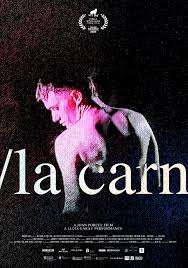
Director: Joan Porcel
Writer: Joan Porcel, Pere Antoni Sastre, Lluís Garau
Starring: Lluís Garau
Year: 2025
Runtime: 83 minutes
Country: Spain
Search database:
